

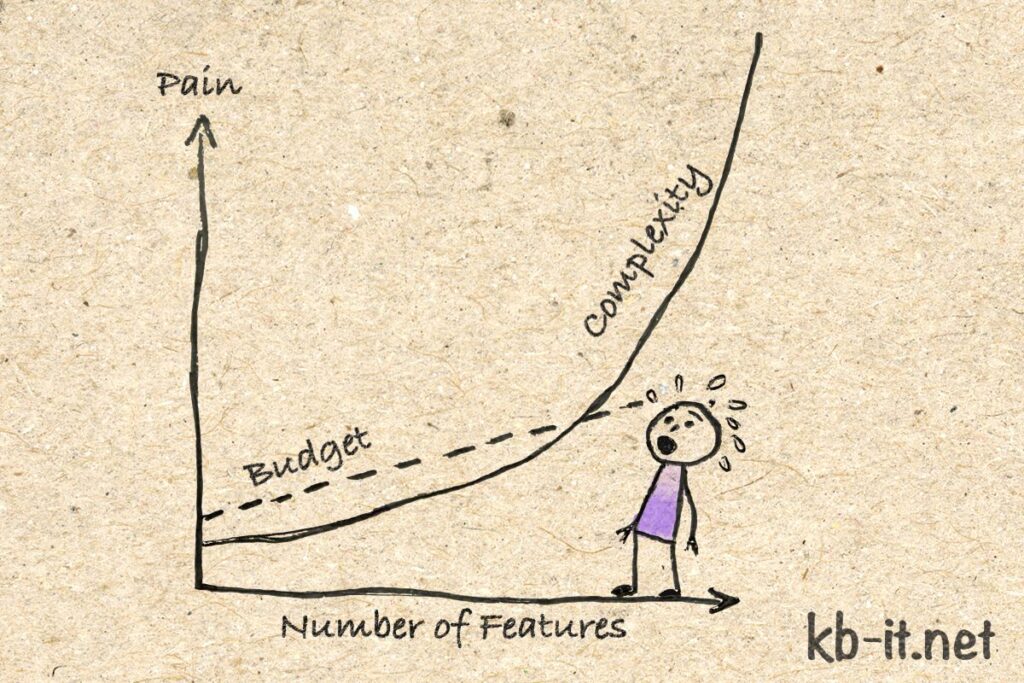
If new features are progress, why do mature systems so often feel slower, harder to change, and more fragile every year?
Quick summary (for busy readers)
- New features create long-term architectural drag, not just short-term cost
- Stakeholder pressure can be reframed using maintenance vs. innovation budgets
- Common enterprise failures are mundane, not dramatic
- Telemetry beats assumptions when deciding whether to build
- Features should have a sunset plan the moment they ship
Why “adding a feature” is deceptively attractive
Features are easy to justify:
- They’re visible progress
- They map cleanly to roadmaps
- Stakeholders can point to them in demos
What’s harder to see is the compounding cost curve:
- More code paths to reason about
- More states to test
- More operational surface to secure and monitor
- More cognitive load for users and on-call engineers
A feature is rarely “just a feature.” It’s a permanent expansion of the system’s problem space.
Stakeholder conflict:
How to reframe the conversation
When architects push back on features, the conversation often stalls at “engineering is blocking progress.” Saying “no” rarely works.
A more effective tactic is to reframe the discussion in budget terms.
The Maintenance vs. Innovation Budget
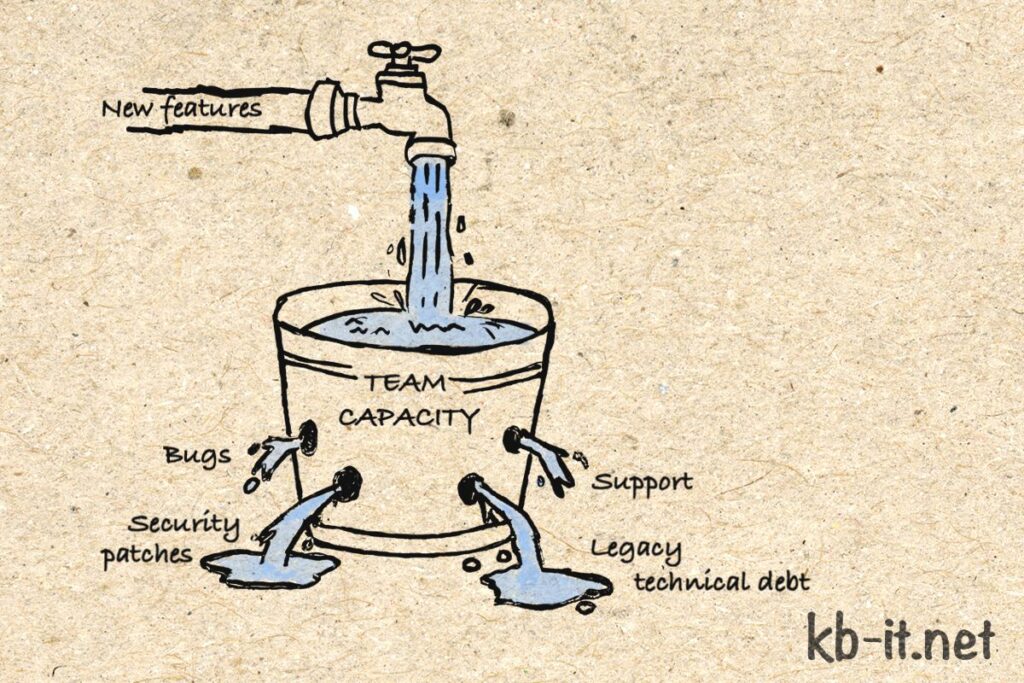
Every system has two invisible budgets:
- Innovation Budget – capacity for new capabilities
- Maintenance Budget – effort spent keeping existing behavior stable
New features withdraw from both:
- Immediately from innovation (build cost)
- Continuously from maintenance (bugs, upgrades, support)
Practical tip:
Instead of rejecting a feature, show stakeholders:
- How much of the next 12 months’ capacity will be consumed maintaining it
- What other initiatives that maintenance load will crowd out
You can make this concrete by tagging Jira tickets as “Feature” vs. “Maintenance / Tech Debt” and showing the trend line over four quarters. Once stakeholders see maintenance steadily eating into delivery capacity, the trade-off becomes visible – and the conversation changes.
A more relatable failure:
The permissions matrix nobody needed
Not all failures are dramatic. Most are painfully ordinary.
The scenario
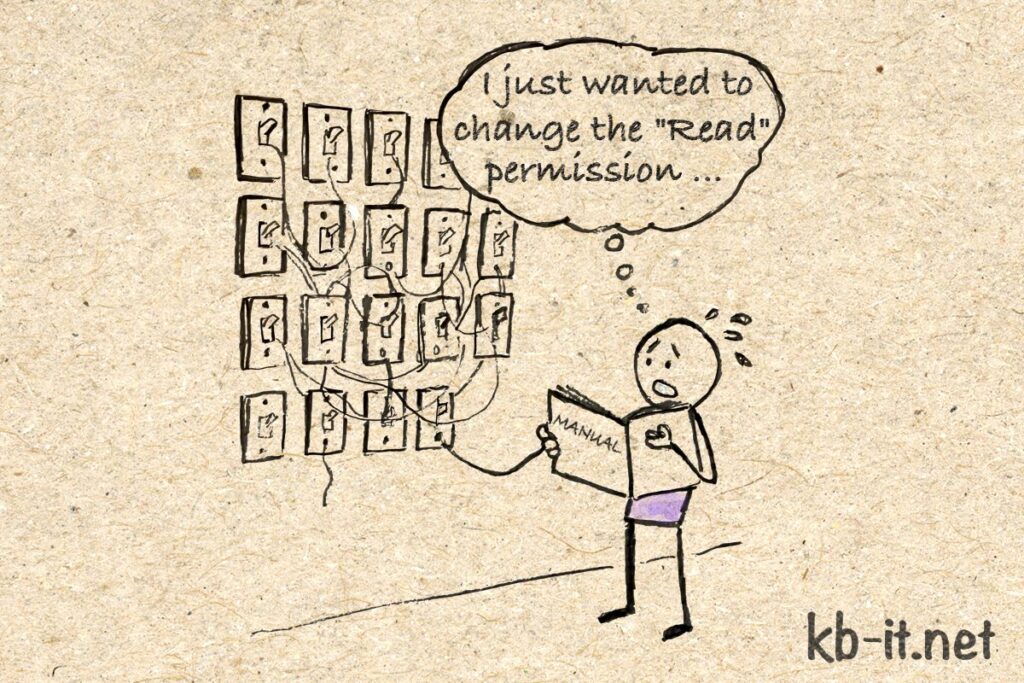
A mid-sized B2B platform started with:
- Two roles: Admin and User
- Clear ownership boundaries
- Simple authorization checks
- “Read-only admin”
- “Billing admin”
- “Support user”
- “Temporary access”
- “Regional admin”
The outcome
- A permissions matrix with dozens of combinations
- Authorization checks on nearly every API call
- Slower response times and harder caching
- Engineers afraid to touch auth logic
- Customers confused about what roles actually meant
In hindsight, 90% of use cases could have been solved with:
- Admin vs. User
- One or two scoped toggles (e.g., billing access)
This is how systems rot – not from ambition, but from unquestioned accumulation.
A mental model you can show on one slide
Use this simple comparison when discussing scope:
| Aspect | Feature Cost | System Complexity | Stakeholder View |
|---|---|---|---|
| Growth pattern | Linear | Exponential | “Steady progress” |
| Visibility | High | Low | “Looks cheap” |
| Reversibility | Medium | Hard | “We can undo it later” |
| Long-term impact | Predictable | Emergent | “Invisible cost” |
Key insight:
You pay for features once. You pay for complexity forever.
This table also explains why feature debates are so difficult: architects experience the exponential curve directly, while stakeholders mostly see what ships.
Deepened practical example:
Killing a feature before it existed
Sometimes small work can bring big value.
The scenario
A team proposed building a Custom Report Builder:
- Drag-and-drop fields
- Filters, joins, export formats
- Significant backend and UI work
- Number of exports per user
- Columns included
- Filters applied
- Time-to-first-export
What the data showed
- 90% of users exported CSVs with the same 3 columns
- Fewer than 5% applied any filters
- Most exports were immediately opened in Excel and modified manually
The outcome
Instead of a report builder:
- The team added saved CSV presets
- Improved default column ordering
- Added one additional filter
Result:
User satisfaction increased, delivery took days instead of months, and the system avoided a major new UI and data-processing surface.
Telemetry turned a speculative feature into a non-event.
Feature = permanently deployed debt
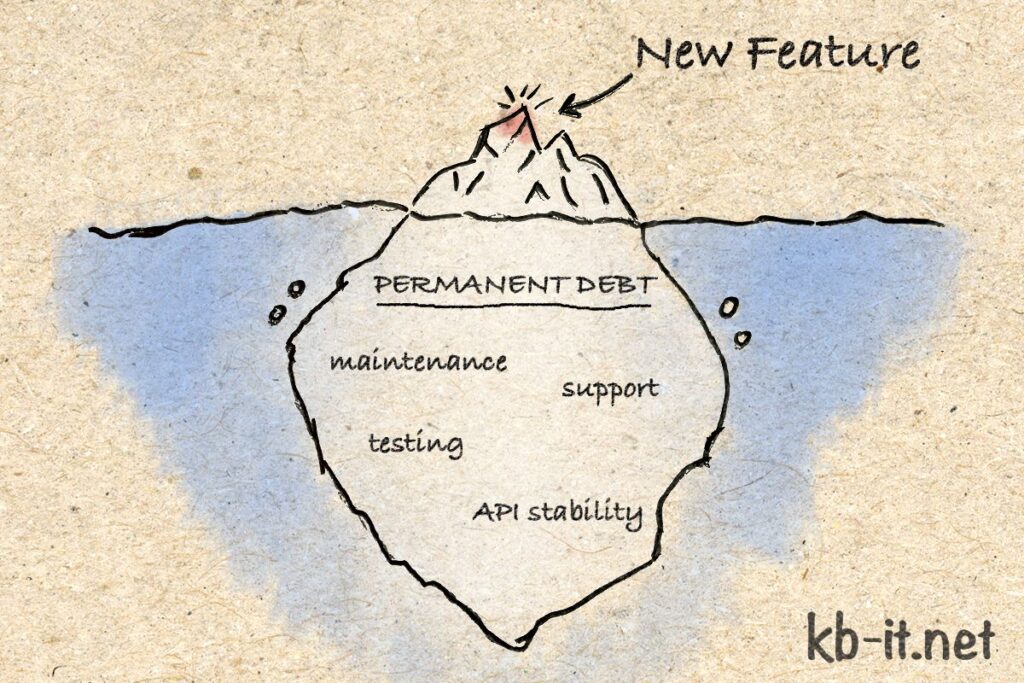
Think of every feature as:
- A library you must support forever
- A behavior users will depend on
- A contract that constrains future design
- You understand the interest rate
- You have a plan to pay it down
Tactical addition:
The sunsetting protocol
If features are debt, retirement must be intentional.
A simple sunsetting protocol
Add this to your architecture or product governance process:
- Usage threshold – Define “healthy usage” (e.g., % of active users, frequency)
- Owner assignment – Every feature has a named owner responsible for its health
- Deprecation signal – Log usage, warn internally when it drops below threshold
- Soft removal:
- Hide from UI, keep API compatibility
- Add observability hooks (e.g., `feature_used` logs or kill switches)
- If the usage signal stays at zero for 30 days, the risk of hard removal is statistically negligible – even for that “one critical customer workflow”
- Hard removal – Delete code paths, schemas, tests.
Critical warning:
If you don’t practice removal, your system will only ever grow – until change becomes impossible.
Common mistakes (and how to avoid them)
-
Mistake: Treating edge cases as feature justification
Fix: Solve edge cases with configuration first -
Mistake: Building before measuring
Fix: Add telemetry as a prerequisite -
Mistake: No exit strategy
Fix: Require a sunset plan in the design doc
Final takeaways
- Feature growth is the fastest way to lose architectural leverage
- Stakeholder alignment improves when cost is framed over time
- Most value comes from refining what already exists
- If features can’t die, systems eventually will
If you remember one thing:
The best systems aren’t defined by what they can do – but by what they deliberately choose not to.